Ayesha
Last night I finished ‘Salvación’ by Sandra Proudman, an ARC I’d received from NetGalley. I’m sorry to report but this was not a hit read for me. You may be asking, “Why’d you request it then Ayesha?” Well, I was pulled in by the description that this was a YA, female version of Zorro. I grew up watching Antonio Banderas in the Zorro movies so I was expecting similar vibes with this read. To put it shortly, the vibes did not match
What was “wrong” with the story – there were a lot of items that were hard to overlook and this factored into my disappointment. For one, the characters were all one dimensional. It’s one thing if it’s the background characters but all of the main characters lacked depth. How are readers supposed to connect if we don’t receive more context for their motivations, their desires, their raison d’être? To add to that, I found the FMC to be very annoying. As a reader, we’re dragged into her internal monologue which was hard to be a part of. There was a lot of whining but not a lot of action or understanding. It came off quite self-entitled which doesn’t help as she’s from a well-off family. Lola is also meant to be a secret vigilante…except her entire family knows about her secret identity. I was befuddled and we lost the excitement factor of trying to hide this identity from others. I could list some more but overall, there were a lot of inconsistencies with this story and it’s not something I would recommend to others, regardless of age group.
Julia
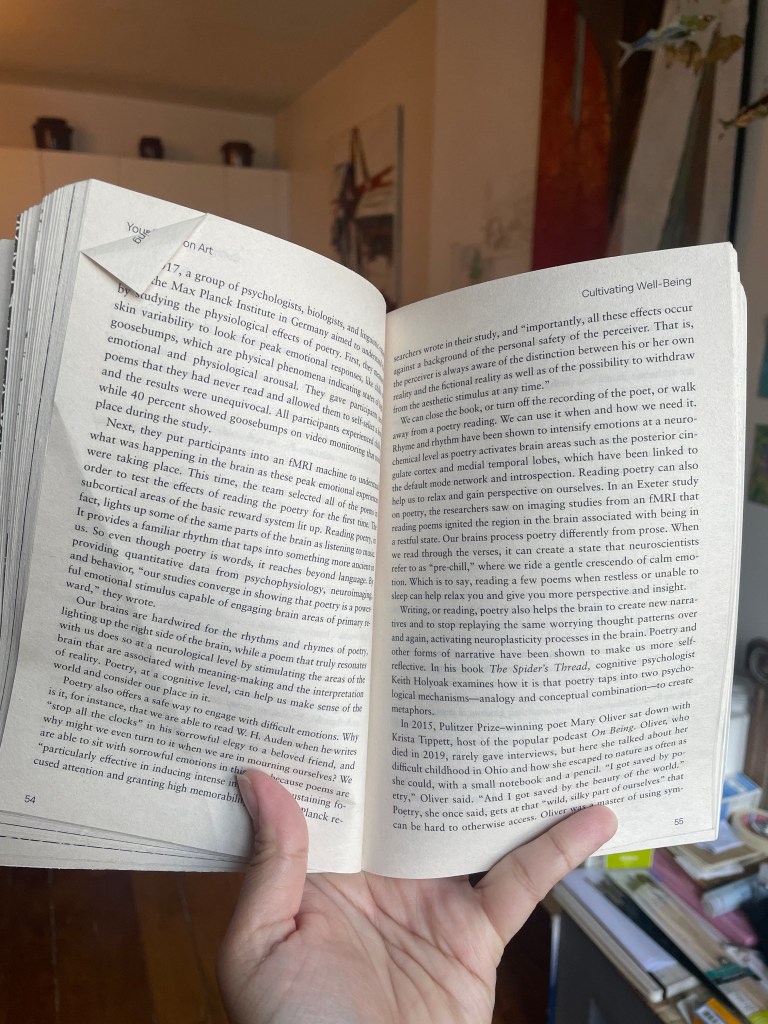
So, I’m still reading ‘Your Brain on Art’, which I wrote about last week, but now that I have gotten a bit further into it, I thought it would be fun to share some insights from the book. In particular, there was a section about the importance of literature and specifically poetry, the world’s oldest form of literature, that I thought would be particularly powerful to expound on here! We talk about poetry and writing a fair amount on our podcast and have spoken to poets about their work – needless to say, we love the written word in all of its forms! We have also discussed the myriad of ways in which reading is ‘therapeutic’ and an overall positive influence on our lives, and as this book shows, the science absolutely backs this up!
‘Reading poetry, in fact, lights up some of the same parts of the brain as listening to music. It provides a familiar rhythm that taps into something more ancient in us. So even though poetry is words, it reaches beyond language…Poetry, at a cognitive level, can help us make sense of the world and consider our place in it…Poetry also offers a safe way to engage with difficult emotions.’
Poetry, in a different way than prose might, not only makes us more resilient and more relaxed, but through helping us rewrite old narratives, also has the ability to change us fundamentally!
Reading about reading poetry and its scientifically proven influence on us has made me even more excited to read and write poetry, and I hope this little insight inspires everyone to do the same.
 Hot Girls Read Podcast
Leave a comment